
Jump to section
Summarize with ChatGPT Claude Perplexity
TL;DR
- Choose self-paced GEO training for flexible access, and choose live instruction when you need scheduled Q&A, practice or explicitly published feedback.[9][4]
- Brick Marketing publishes a $175 live class with a one-hour follow-up consultation, while Anna York’s $799 cohort publishes personal written feedback on submissions.[1]
- HubSpot, Semrush and Ahrefs publish free GEO or AEO learning options with different certificate conditions.[4]
- SMX Next is a free live online event on 18 November 2026, whereas SMX Master Classes are paid recordings in November rather than new live workshops.[17]
- Research from other training fields does not prove that live delivery alone produces better learning outcomes, so compare the actual feedback, practice and access terms.[4]
Live or self-paced: the short answer
Choose a self-paced GEO course when flexibility, a defined curriculum and low or no tuition matter most. Choose a live GEO workshop or cohort when you specifically need scheduled accountability, instructor questions, practical exercises or published feedback on your own work.
The live label alone does not guarantee a website review or better learning outcomes. Brick Marketing publishes a $175 live class with a one-hour follow-up consultation, while Anna York’s $799 Maven cohort publishes personal written feedback on submissions; those concrete services are more useful comparison points than delivery mode alone.[1]
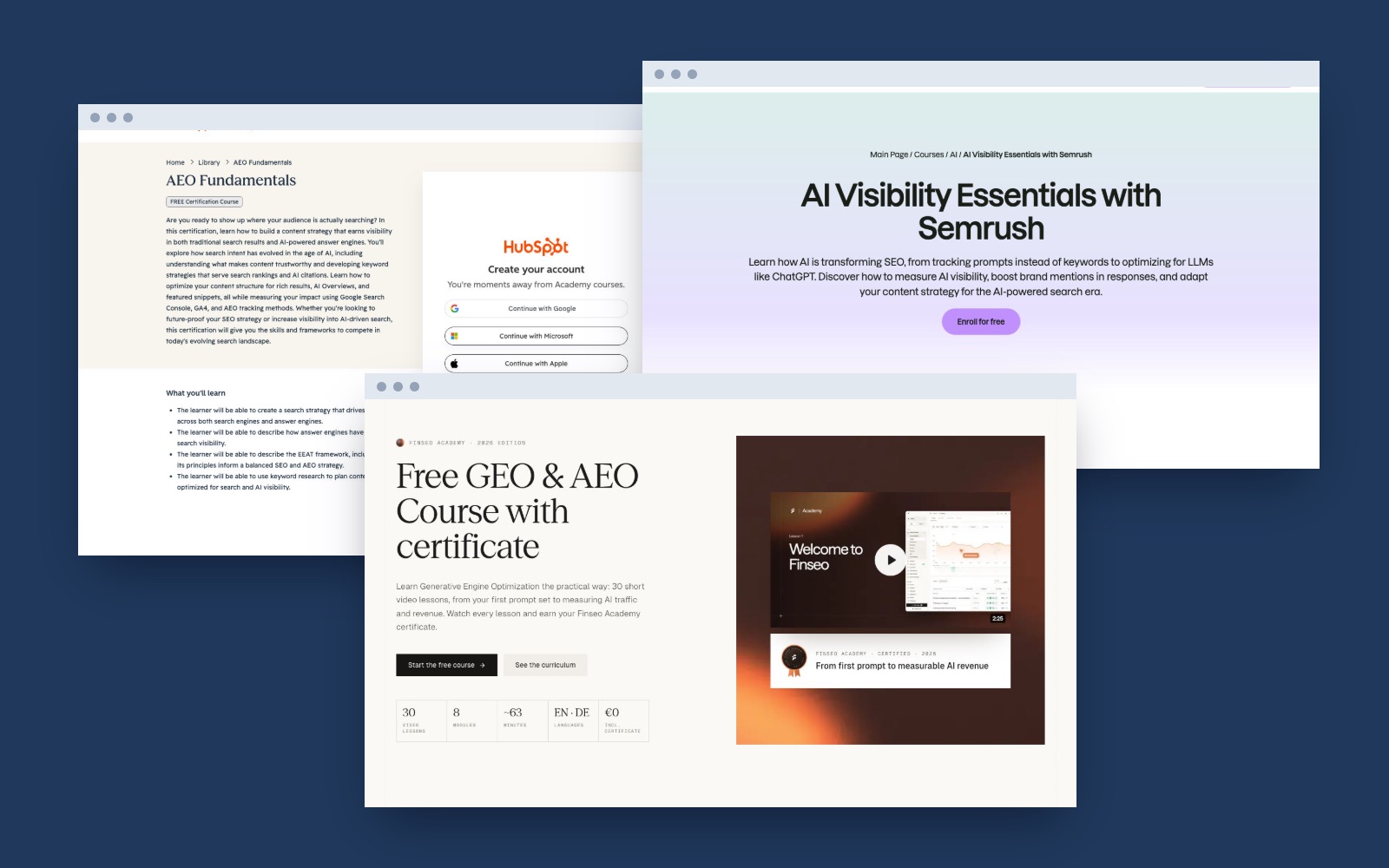
Free or included courses can also provide certificates. HubSpot publishes a free AEO certification course, Semrush offers a free AI visibility course and Finseo advertises a free GEO/AEO course whose certificate is included with every Finseo plan.[2][3] For teams weighing that plan, Finseo lists SSO via SAML, roles per project, an audit trail and unlimited seats on its enterprise page. It is hosted in Frankfurt, Germany with EU data residency, is GDPR-compliant with a data processing agreement (DPA) and is ISO 27001 certified.
This comparison uses provider-published formats, dates, prices and deliverables checked on 15 November 2026. “Not published” means the reviewed provider page did not state the detail; it does not mean the provider never offers it.
What does each format include?
GEO, or generative engine optimization, is the practice of improving how brands and content appear in AI-generated answers and answer-engine results. Courses may use the related term AEO, or answer-engine optimization, especially when they focus on structuring content for AI answers.
The main formats differ in how much structure and interaction they provide:
| Format | Example providers | Price as published | Live feedback | Certificate | Best for |
|---|---|---|---|---|---|
| Self-paced tool academy | HubSpot, Semrush, Ahrefs | Free; Finseo is included with every Finseo plan | Exercises or assessments; personal site review not published | Available from each provider under different conditions | Foundations and tool-aligned learning |
| Self-paced marketplace course | Udemy, Coursera | Udemy listing: $34.99; Coursera certificate price not published | Not live; course support varies | Udemy lists completion certificate; Coursera advertises a shareable certificate | Flexible individual study |
| Short live workshop | Brick, DMAnc, SEO Pro Academy | $175; $500; EUR399 | Q&A or exercises; Brick adds follow-up consultation | Provider-specific; SEO Pro Academy lists participation certificate | Focused training on a fixed date |
| Live cohort | Maven courses by Mostafa ElBermawy and Anna York | $499 and $799 USD | York publishes written submission feedback; office hours also published | Certificates of completion | Guided application and accountability |
| Conference learning | SMX Next, SMX Master Classes, brightonSEO | Free; $299; GBP900 plus VAT for the cited Brighton event | Live Q&A only where the ticket includes it | SMX lists attendance or completion credentials | Expert talks, networking and event-based learning |
A live workshop can include Q&A without including a personal audit. DMAnc publishes demonstrations, exercises, recordings and supporting materials, but not a guaranteed individual website review.[4] SEO Pro Academy publishes Q&A and access to its learning environment, while personal site feedback and recording terms are not published on the examined page.[4]
A self-paced course can still include practical work. HubSpot lists four practical exercises in its 2-hour-58-minute AEO certification course.[5] Semrush lists a 20-lesson, one-hour AI visibility course and a final assessment for its certificate.[6]
The clearest format distinction is therefore not “video versus live.” It is watching information versus receiving a defined opportunity to apply, submit, discuss or revise work.
How much does GEO training cost?
Published prices range from free courses to paid live and conference formats. The prices below reproduce the providers’ published currency and wording; tax treatment is not added where the provider does not state it.
Live workshops and cohorts
- Brick Marketing: $175 per person for a one-day virtual class on 18 November 2026. The offer includes Q&A, replay access, materials and a one-hour follow-up consultation usable for a website review or implementation questions.[7]
- DMAnc: $500, advertised as reduced from $1,000, for two live online modules on 18 November and 2 December 2026. The page does not clearly state whether the price covers both modules or separate enrollment.[8][9]
- SEO Pro Academy: EUR399 for a four-hour live AI Search masterclass on 18 November 2026, with Q&A and a certificate of participation.[10][11]
- Maven, Mostafa ElBermawy: $499 USD for two live sessions on 18–19 November 2026, with recordings, lifetime content access and a certificate of completion.[11]
- Maven, Anna York: $799 USD for a cohort running from 24 November to 13 December 2026. It includes live sessions, personal written replies to submissions, optional office hours, recordings and lifetime content access.[1]
- Ifop/Deep Opinion: EUR1,000 excluding VAT per participant for a 23 November 2026 GEO training session. Delivery mode, feedback, recordings and certificate terms are not published.[4]
Endtrace’s six-hour Zoom workshop cost US$60 per participant, included a guided website-content exercise, Q&A and recordings, and explicitly excluded a complete website audit or done-for-you implementation. Its 10–11 November session had already taken place by the 15 November snapshot.[12][13]
Self-paced courses
- HubSpot Academy: Free AEO certification course lasting 2 hours 58 minutes, with seven lessons and four practical exercises.[5]
- Semrush Academy: Free 20-lesson AI visibility course lasting approximately one hour; a Semrush account is required.[14]
- Ahrefs Academy: Free AEO course with 12 lessons across five modules and a published runtime of 1 hour 26 minutes. Ahrefs separately lists an AEO certification exam.[15]
- Finseo Academy: Approximately 63 minutes across 30 short video lessons and eight modules. Finseo advertises the course as free, while its FAQ says the lessons and certificate are included with every Finseo plan; standalone access without a plan is not published.[3][16]
- Udemy: The examined GEO course lists 19 lectures and 2 hours 36 minutes of content, with an individual purchase price displayed at $34.99 and subscription access advertised from $13 per month.[8]
- Coursera: The examined GEO course lists four hours, two modules and four assignments and explicitly says learners can study at their own pace. The certificate price is not published in the retrieved listing.[9][16]
These prices should not be treated as a quality ranking. A $175 workshop with a defined follow-up consultation may be more useful to one learner than a $799 cohort focused on building no-code AEO agents. Conversely, the cohort may better fit someone who needs repeated practice and written feedback.[1]
Which format fits your learning goal?
Choose self-paced training when flexibility matters
Self-paced courses are a practical starting point for marketers who need to learn around client work, campaigns or other responsibilities. Coursera explicitly describes its GEO course as self-paced, while Udemy provides an individual purchase option for a defined curriculum.[4]
This format is also suitable when the learner wants a low-risk introduction. HubSpot, Semrush and Ahrefs publish free courses, although their certificate and access conditions differ.[4]
Tool academies may be especially efficient when a team already uses the provider’s platform. HubSpot’s course teaches AEO alongside practical exercises, Semrush’s course focuses on AI visibility using its toolkit, and Finseo describes lessons recorded in its product with real data.[5][2]
Choose a live workshop when you need a scheduled intervention
A one-day or half-day workshop can help a team reserve time for a new topic instead of leaving a course indefinitely unfinished. Brick’s class runs on a fixed date and adds a follow-up consultation that can address implementation questions or review a website.[7]
A short workshop is a better fit when the required outcome is narrow, such as understanding AI search, reviewing content priorities or learning a specific workflow. It is less suitable when the learner wants months of practice unless recordings, follow-up access or additional support are explicitly included.
Choose a cohort when feedback is the priority
Cohorts provide more than a single presentation when learners submit work, receive comments and return for another session. Anna York’s course publishes personal written replies to submissions and optional office hours, making the feedback mechanism explicit.[1]
Mostafa ElBermawy’s Maven course publishes two live sessions, recordings and lifetime content access, but a guaranteed individual website review is not published.[11] That distinction matters: live teaching and personal consulting are separate services.
Choose conference learning when breadth and expert access matter
SMX Next is free and online on 18 November 2026, with Q&A after most sessions, on-demand access to sessions and Q&As, an attendance certificate and a digital badge.[17]
SMX Master Classes are a different product. The October classes are available on demand at a standard price of $299 per class, with access through 13 October 2027. Live instructor Q&A is available only during the live offering, so the November purchase should not be described as a new live workshop.[4]
The cited brightonSEO course cost GBP900 plus VAT and bundled one training day with entry to two conference days, but its 7 October 2026 event was marked closed.[18] Its price is therefore a historical 2026 comparison, not a current November booking.
How should you compare feedback, pace and certificates?
Use the following checklist before enrolling:
- What specific work will you submit or review? Look for a named exercise, site review, written feedback or consultation rather than assuming a live chat provides personal guidance.
- Is attendance required at a particular time? Check the date, time zone, delivery platform and replay terms before choosing a live workshop.
- How much instructor access is actually included? Separate group Q&A, office hours, written feedback and one-to-one consultation because they are not equivalent.
- What does the certificate represent? Distinguish attendance, participation, completion and assessed certification.
- Is the course current enough for your use case? A 2026 course label or recent update may be useful, but providers do not all publish revision dates or update schedules.[19]
- Does the course require a particular tool or account? Tool-specific academies can be efficient for existing customers but less transferable to teams using other platforms.
- What happens after the course? Check whether recordings, materials, lifetime access, implementation support or follow-up tasks are included.
- Does the team need a private curriculum? A public cohort price is not a private-team quote; Maven publishes private cohorts, but private pricing is not published.[9][20]
- Is the advertised price individual or organizational? Udemy lists $34.99 for an individual course, while Udemy Business lists $360 per user billed annually for its Team Plan; the team page does not establish that the particular GEO course is included.[21]
- What would success look like? Define whether success means course completion, a content audit, an improved workflow, better prompt coverage or a team-wide operating process. If you want a measurable outcome, Finseo’s GEO case studies show visibility changes verified in Finseo’s own tracking.
What should teams check before buying?
How should a company train a whole marketing team?
Start by deciding whether the team needs shared awareness, practical implementation or ongoing coaching. Free academies can provide a common vocabulary and completion record, while a live workshop or private cohort may be more appropriate when everyone must apply the method to the same site or workflow.[4]
Separate learning administration from expert support. Udemy Business publishes team assignment and engagement analytics, and HubSpot publishes certification-progress reporting; neither cited page establishes that a particular GEO course includes live consulting.[21] Maven publishes private cohorts with custom schedules and curricula, but private pricing is not published.[20]
For a team purchase, request written answers to four questions: whether the provider reviews the company’s own site, how many feedback interactions are included, whether recordings remain available, and what certificate each participant receives. Do not multiply an individual course price into an assumed enterprise quote.
What does the evidence say about live learning?
Research does not establish a universal live-learning advantage for GEO. A randomized comparison involving 1,044 paramedic-course completers found no significant post-training knowledge difference between synchronous and asynchronous formats, although asynchronous learners showed greater overall acceptance and live learners reported greater intrinsic motivation and pressure.[4]
A randomized workplace study found that both web-based and blended training improved measured well-being outcomes compared with a control group, but adding group sessions did not generally outperform the self-paced format.[22] These findings concern workplace well-being and paramedic education, not GEO performance, content visibility or business revenue.
A separate pilot trial tested a more intensive coached-practice package with 72 emergency physicians. It combined repeated videoconference sessions, simulation and immediate personalized expert feedback; 28 of 30 intervention physicians completed all sessions, and the intervention group transferred severely injured patients correctly in simulation more often than controls.[16]
That result supports the value of practice plus feedback in that specific setting, not live video by itself. The trial included repeated tasks and expert coaching, and its authors noted limitations including a passive control and limited generalizability.[16]
Completion is another reason to examine course structure. A study of 221 MOOCs, with completion data available for 129, found completion rates ranging from 0.7% to 52.1%, with a median of 12.6% among enrolled learners.[19] That figure describes a broad observational MOOC dataset and should not be used to predict completion for a particular paid workshop or short GEO course.
The practical conclusion is narrower: choose the format that supplies the behavior you need. If you need feedback, buy an offer that explicitly includes feedback. If you need flexibility, choose on-demand access. If you need accountability, choose a scheduled workshop or cohort. The format label alone is insufficient.
Frequently asked questions
Is a live GEO workshop better than a self-paced course?
Not automatically. Available research in other training contexts does not establish a universal knowledge advantage for synchronous delivery, while some live providers do publish useful extras such as Q&A, scheduled practice or individual follow-up.[4] Choose according to the specific service you need rather than the live label.
What is the cheapest way to learn GEO?
Several provider academies publish free courses, including HubSpot, Semrush and Ahrefs.[14] Finseo advertises a free GEO/AEO course, but its FAQ says the Academy is included with every Finseo plan, so standalone access without a plan is not published.[3]
Which GEO courses include feedback on my own website?
Brick Marketing publishes a one-hour follow-up consultation that can be used for a website review, implementation questions or validation of next steps.[7] Anna York’s Maven cohort publishes personal written replies to learner submissions, while the other reviewed courses do not publish a guaranteed individual site audit.[1]
Do GEO courses provide certificates?
Many do, but the credential types differ. Semrush and HubSpot publish free certificates, SMX Next lists an attendance certificate and digital badge, and SEO Pro Academy lists a certificate of participation.[17] A certificate of attendance or completion should not automatically be treated as assessed professional accreditation.
How much does live AEO training cost?
The reviewed live options range from $175 for Brick Marketing’s virtual class to $1,000 excluding VAT for the cited Ifop/Deep Opinion session.[7][12] Maven lists $499 and $799 USD for two different cohorts, while SEO Pro Academy lists EUR399.[1] Prices reflect different durations, feedback mechanisms and subject areas.
Can a whole marketing team take a GEO course together?
Yes, but the published options differ. Udemy Business lists team administration and analytics at $360 per user billed annually, Maven publishes private cohorts with custom schedules, and HubSpot publishes team certification-progress features.[21] The cited pages do not establish that every individual GEO course is included in a business plan or provide a universal private-workshop price.
Sources
- Build Your Own AI SEO Agents: A No-Code AEO Bootcamp for Marketers by Anna York on Maven · maven.com
- Free GEO/AEO Course & Certificate | Learn Generative Engine Optimization · finseo.ai
- Pricing, Starter, Business, Growth & Enterprise | Finseo · finseo.ai
- Randomized controlled trial of asynchronous vs. synchronous online teaching formats: equal knowledge after training, greater acceptance and lower intrinsic motivation through asynchronous online learning - PMC · pmc.ncbi.nlm.nih.gov
- Implementing AEO With HubSpot · academy.hubspot.com
- AI SEO Course: Optimize for LLMs like ChatGPT - Semrush Academy · semrush.com
- Boston SEO, AI Search (GEO) & Content Marketing Training Class · brickmarketing.com
- Generative Engine Optimization (GEO): The Complete Guide · udemy.com
- The evaluation of synchronous and asynchronous online learning: student experience, learning outcomes, and cognitive load | BMC Medical Education | Springer Nature Link · link.springer.com
- Live masterclass AI Search (incl. Q&A) - 18 november 2026 · seopro.academy
- AEO Masterclass: AI Search Beyond SEO by Mostafa ElBermawy on Maven · maven.com
- GEO Training : How to Be Visible in New AI Search Engines - Ifop Group · ifopgroup.com
- Hands-on Live GEO Workshop with Practical Exercise · endtrace.com
- Free AI Search Courses & Certifications | Semrush Academy · semrush.com
- Ahrefs Certification - Get officially Ahrefs Certified · ahrefs.com
- Testing a Novel Deliberate Practice Intervention to Improve Diagnostic Reasoning in Trauma Triage: A Pilot Randomized Clinical Trial | Surgery | JAMA Network Open | JAMA Network · jamanetwork.com
- Why Attend | SMX® Next | Online November 18, 2026 · searchengineland.com
- Copywriting for Google and AI Search training course at brightonSEO · brightonseo.com
- Massive Open Online Course Completion Rates Revisited: Assessment, Length and Attrition · irrodl.org
- Private cohorts | Maven Help Center · help.maven.com
- Learning Plans for Businesses | Udemy Business · business.udemy.com
- Comparing Web-Based and Blended Training for Coping With Challenges of Flexible Work Designs: Randomized Controlled Trial - PMC · pmc.ncbi.nlm.nih.gov